


Low-Carbon Exports Reduce CO2 Emissions
Researchers at the HSE Faculty of Economic Sciences and the Federal Research Centre of Coal and Coal Chemistry have found that exporting low-carbon goods contributes to a better environment in Russian regions and helps them reduce greenhouse gas emissions. The study results have been published in R-Economy.

Russian Scientists Assess Dangers of Internal Waves During Underwater Volcanic Eruptions
Mathematicians at HSE University in Nizhny Novgorod and the A.V. Gaponov-Grekhov Institute of Applied Physics of the Russian Academy of Sciences studied internal waves generated in the ocean after the explosive eruption of an underwater volcano. The researchers calculated how the waves vary depending on ocean depth and the radius of the explosion source. It turns out that the strongest wave in the first group does not arrive immediately, but after a significant delay. This data can help predict the consequences of eruptions and enable advance preparation for potential threats. The article has been published in Natural Hazards. The research was carried out with support from the Russian Science Foundation (link in Russian).

'Multidisciplinary Expertise Must Be Grounded in a Deep Understanding of Country Specifics'
During the Russia—Islamic World: KazanForum held in Kazan, experts from the HSE Institute for Public Administration and Governance (IPAG) presented the results of studies analysing the potential for establishing multimodal transport and logistics hubs along international transport corridors. One of the key sessions titled The International North–South Transport Corridor and attended by Deputy Prime Ministers Vitaly Savelyev and Marat Khusnullin highlighted the progress towards attaining the objective set by Russian President Vladimir Putin regarding the advancement of Russia's foreign trade potential.

HSE University–St Petersburg Presents Project on Social Entrepreneurship at Session of Russian–Malaysian Working Group
Alexander Sorokin, Dean of the St Petersburg School of Social Sciences, presented the results of a joint Russian–Malaysian mirror laboratory project in social entrepreneurship at the second meeting of the Russian–Malaysian Working Group on Education, Science, and Technology at the Universiti Teknologi Malaysia (UTM).

Happiness as an Industry: Why We Want to Be Happy—And What’s Wrong with That
The expansion of ‘happycracy’ into everyday life unfolds against the backdrop of a diktat of positive thinking, mindfulness, and self-improvement. Yet researchers point to the hidden traps in the pursuit of happiness. Why can being happy sometimes be dangerous? Maria Kucheryavaya, sociologist and visiting lecturer at the HSE School of Communication, reflects on this in her column for IQ Media.

How the Brain Responds to Prices: Scientists Discover Neural Marker for Price Perception
Russian scientists have discovered how the brain makes purchasing decisions. Using electroencephalography (EEG) and magnetoencephalography (MEG), researchers found that the brain responds almost instantly when a product's price deviates from expectations. This response engages brain regions involved in evaluating rewards and learning from past decisions. Thus, perceiving a product's value is not merely a conscious choice but also a function of automatic cognitive mechanisms. The results have been published in Frontiers in Human Neuroscience.

'Science Is Fluid and Evolving Quickly. You Have to Stay on Top of It'
Vladimir Dimidov specialises in positive psychology and investigates the issue of time perspective. In this interview with the HSE Young Scientists project, he discusses the importance of thinking about the future, strategies for preventing burnout, and the best places to visit on Lake Baikal.
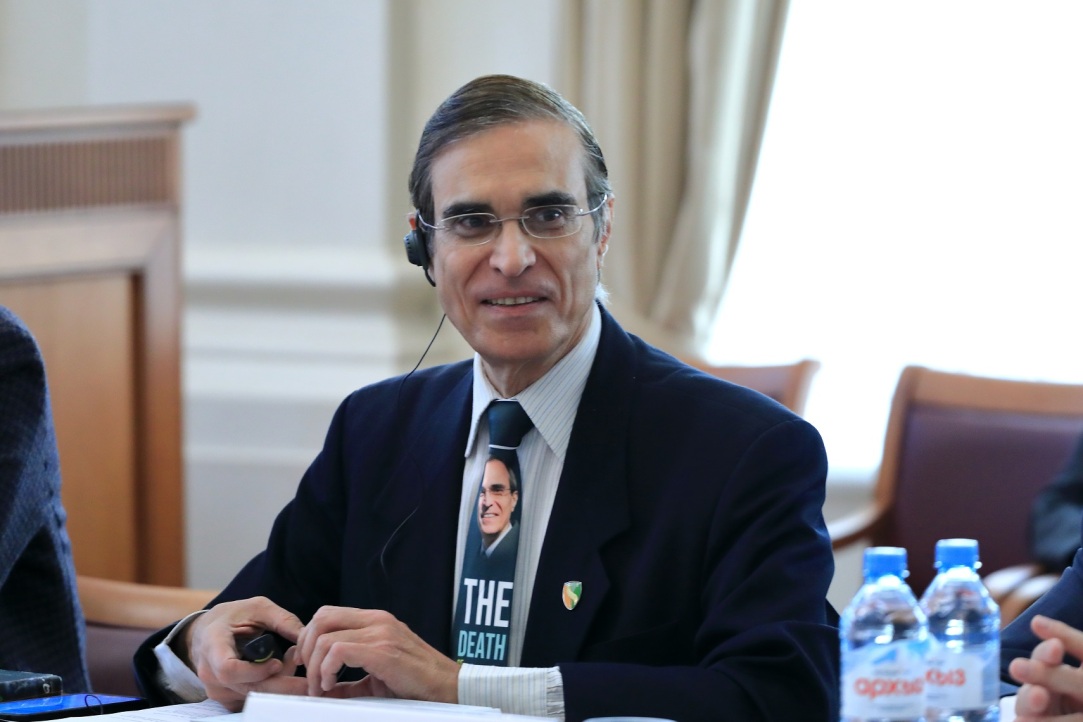
‘In the Next 20 Years, We Will Stop Aging’
The 25th Yasin (April) International Academic Conference on Economic and Social Development brought together leading Russian and Western scientists. Among the guests was Jose Luis Cordeiro, PhD, international fellow of the World Academy of Art and Science, Chair of the Millennium Project's Venezuela node, former professor at MIPT and HSE University, and author of The Death of Death.

Experts in Asian and African Studies from HSE University–St Petersburg Hold International Russian–Omani Seminar
HSE University–St Petersburg has held the first 'Studies of Oman in Russia: New Directions for Scientific Research' international research seminar. The event gathered researchers from Russia, Oman, and Europe and served as a platform for an open academic dialogue.

AI Predicts Behaviour of Quantum Systems
Scientists from HSE University, in collaboration with researchers from the University of Southern California, have developed an algorithm that rapidly and accurately predicts the behaviour of quantum systems, from quantum computers to solar panels. This methodology enabled the simulation of processes in the MoS₂ semiconductor and revealed that the movement of charged particles is influenced not only by the number of defects but also by their location. These defects can either slow down or accelerate charge transport, leading to effects that were previously difficult to account for with standard methods. The study has been published in Proceedings of the National Academy of Sciences (PNAS).