

HSE Winter School on Analytics and Data Science Brings Together Specialists in Different Fields
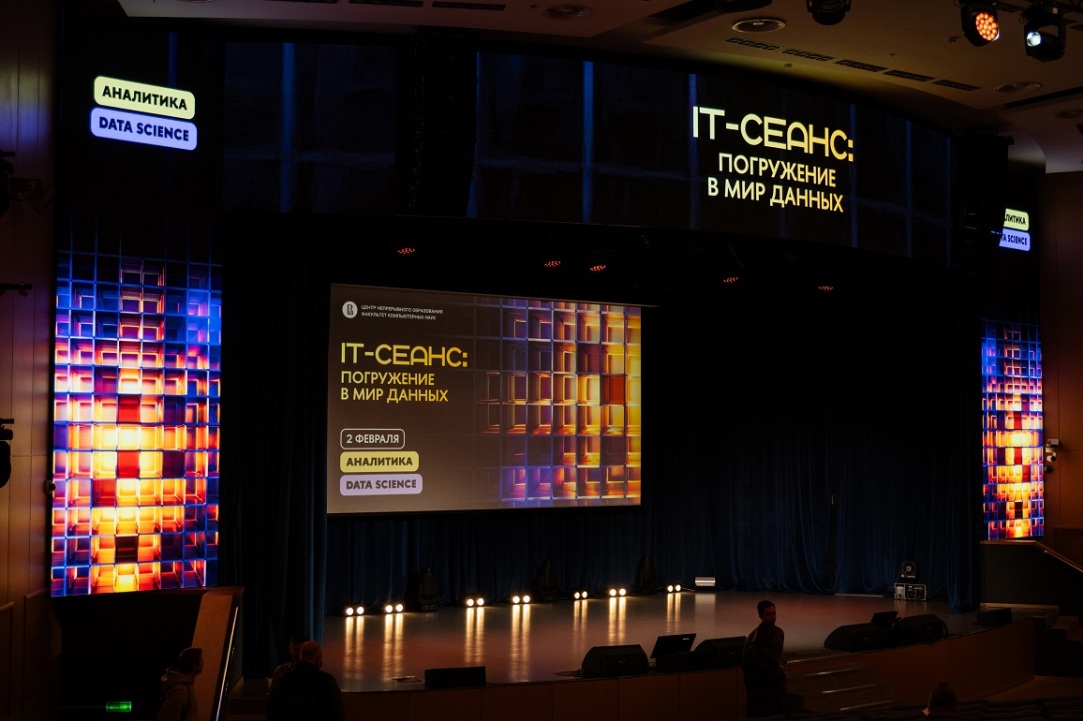
In early February, the HSE Cultural Centre hosted ‘IT Session: Immersion in the Data World’, a winter school on analytics and data science organised by the Continuing Education Centre of the Faculty of Computer Science. More than four hundred participants attended lectures by speakers from Yandex, T-Bank, MTS, Okko, Kuper, Avito, Bank of Russia, Beeline, as well as FCS experts. The event gathered both early-career analysts and students, as well as experts seeking to better understand how analytics and data science can be applied in various industries.
New Career Opportunities and Various Participants
The school’s participants included specialists who were not directly related to IT but wanted to learn how to apply data analysis in their current activities. There were also students who plan to engage in data science and want to find an optimal career path. Students learnt how theoretical tools can be applied in practice and communicated with industry representatives. The school's programme included several tracks and a variety of presentation formats, from an introductory lecture on trends in analytics and data science to reports on ML tools and applied tasks.
General Track: Main Trends
Daria Kasyanenko, an expert and teacher at the Continuing Education Centre of the Faculty of Computer Science, delivered a welcoming speech at the school’s opening. She provided an overview of important vectors of development in analytics and data science, emphasising the roles of data streaming, integration of artificial intelligence, advanced analytics, and cloud platforms. Daria noted that the development of technological capabilities requires specialists to constantly update their competencies and be ready for the rapid introduction of new technologies.

Industry Parallels: Overview Track and Tools and Technologies
The participants could choose one of two tracks:
Overview Track
Elen Tevanian, Head of ML in Operations at Kuper, showed what kind of ML tasks are solved in the e-com service and how technologies help to increase usability. Anton Skogorev, Technical Director of the T-Bank AI Center, explained how applications based on generative AI are created: from simple single-prompt scenarios to more complex chains of agents.
Alexander Kondrashkin, Head of Analytics at Okko, explained how online cinema works, what tasks analysts solve, and how competent data management benefits businesses.

Tools and Technologies
Ivan Gudkov, Lead Economist at the Bank of Russia, demonstrated the main types of ML tasks in the banking sector and showed how NLP works in financial structures. The participants saw a step-by-step solution to an applied problem and got acquainted with the features of machine learning integration in a large company.
Anton Semenisty, Senior DS Engineer at the Avito Monetization Department, presented a detailed overview of the algorithms used in the platform, from advertising auctions and autobidding to probabilistic models for predicting user targets.
Artur Samigullin, Team Lead at YandexArt, spoke about evaluating the quality of generative models, having considered the features of pointwise and pairwise markup. Using case examples, the speaker examined the difficulties faced by analysts when testing such systems and how they find optimal solutions for various cases.


Big Data and AI
The final report was presented by Alina Sadukevich, Chief Product Officer at Beeline. Alina described the creation of products based on big data and artificial intelligence, and which elements fall into each of these categories.
Networking and Informal Communication
In the evening, the participants had a networking session where they could ask additional questions to the speakers, exchange contacts, and discuss the lectures. In addition, the winners of interactive contests organised within the school received prizes.
Courses and programmes of the Continuing Education Centre of the Faculty of Computer Science will start in the near future.
The online course ‘Programming in Python’ serves as an introduction to one of the most popular modern programming languages. Python with its libraries is a universal tool for solving many applied tasks. Students will learn how to program from scratch, learn the features of Python syntax and how to apply it to solve problems in a wide variety of fields, and master data analysis, visualisation, and data collection from online resources.
The online course ‘SQL for Beginners’ will help students master the SQL language from scratch: basic queries, grouping tables and aggregating functions, working with strings and dates, window functions.
The Data Analyst professional retraining programme covers the study of databases and SQL, as well as Python, its application for data collection, visualisation and analysis, statistics and machine learning, analytical and product approaches to working on tasks.
The Data Science Specialist programme immerses students in modern data analysis and machine learning, from learning programming and basic mathematics to deep learning, applied statistics, and working with big data.
The online course ‘Analytics in Business Intelligence’ is dedicated to working with BI systems using the example of Tableau and DataLens. Students will learn how to use Business Intelligence to visualise and prepare data for further work, as well as how to set up a dashboard that satisfies the customer.
See also:

HSE Faculty of Computer Science Holds 3rd Winter School in Software Engineering
For the third time, HSE University Faculty of Computer Science has held a winter school in software engineering, with over 1000 participants registering for the event. Representatives from the Faculty of Computer Science and its partner companies, including Yandex, Sber, Tinkoff, and MTS, delivered lectures at the school.
‘Anybody Who Does Not Believe in the Importance of Sustainable Development Should Visit India’
In January 2024, HSE students from Moscow, St Petersburg and Nizhny Novgorod took part in the Winter School ‘Business and Governance in India’, hosted in Dehradun by the University of Petroleum and Energy Studies (UPES). Having now completed the course, its attendees—participants of the Master’s in Sustainable Business Management at HSE Graduate School of Business—shared their impressions with the HSE News Service.
HSE University’s Faculty of Computer Science to Hold 2024 Winter School on Software Engineering
On February 26–29, 2024, HSE University’s Faculty of Computer Science will hold a winter school on software engineering for the third time. It will focus on modern software development tools and methods. From February 26 to 28, the school will be held online, and on February 29, it will take place at the HSE University building on Pokrovsky Bulvar in Moscow. Those interested can register to participate until February 22.
‘My Research Has Evolved into A Broader and More Encompassing Vision’
Seungmin Jin, from South Korea, is researching the field of Explainable AI and planning to defend his PhD on ‘A Visual Analytics System for Explaining and Improving Attention-Based Traffic Forecasting Models’ at HSE University this year. In September, he passed the pre-defence procedure at the HSE Faculty of Computer Science School of Data Analysis and Artificial Intelligence. In his interview for the HSE News Service, he talks about his academic path and plans for the future.
Demand for Master’s Degrees in Data Science Quadruples Since Last Year
According to analytics from HSE University’s online campus, the demand for the Master of Data Science online Master’s programme has quadrupled, and the number of applicants doubled compared to last year (more than 250 students). Data science ranks first in demand among all HSE master’s degree programmes taught online.
HSE Faculty of Computer Science Holds Second Winter School on Software Engineering
This year, 625 applications from 90 cities were submitted to participate in the second Winter School on Software Engineering at the HSE Faculty of Computer Science. The main topics were software architecture, mobile development, digital twins, artificial intelligence, cloud services development, API, technical debt, QA, software systems, Flutter, and distributed systems.
HSE Co-organises Floating University
Floating University is a national project to help students and young scientists immerse themselves in Earth science research and undertake an expedition aboard a research vessel. However, anyone interested in taking part must first go through the training and selection process. For those who dream of going on a scientific voyage, there is a winter school co-organised by HSE University.
‘When I Learned to Implement My Ideas in a Program, I Understood Why It Was Worth Coming to University’
On February 15–17, the HSE University Faculty of Computer Science will hold a winter software engineering school aimed at sharing and exchanging knowledge about modern tools and methods in software development. Those interested in taking part must register by February 12. The HSE News Service spoke to students of the Faculty of Computer Science about their studies on the Bachelor’s programme in Software Engineering.
‘Today Data Is Processed and Interpreted at a Completely Different Level’
Additional enrollment in the online programme ‘Master of Data Science’ is now open. Daniil Kopylov, 1st-year student of the master's programme, told HSE News Service why an international financial specialist should study Data Science.
HSE Faculty of Computer Science Organises Its First Software Engineering Winter School
From February 14–18, the HSE Faculty of Computer Science organised its first international winter school dedicated to software engineering. The event was supported by JetBrains, Innopolis University, and Schaffhausen Institute of Technology.