

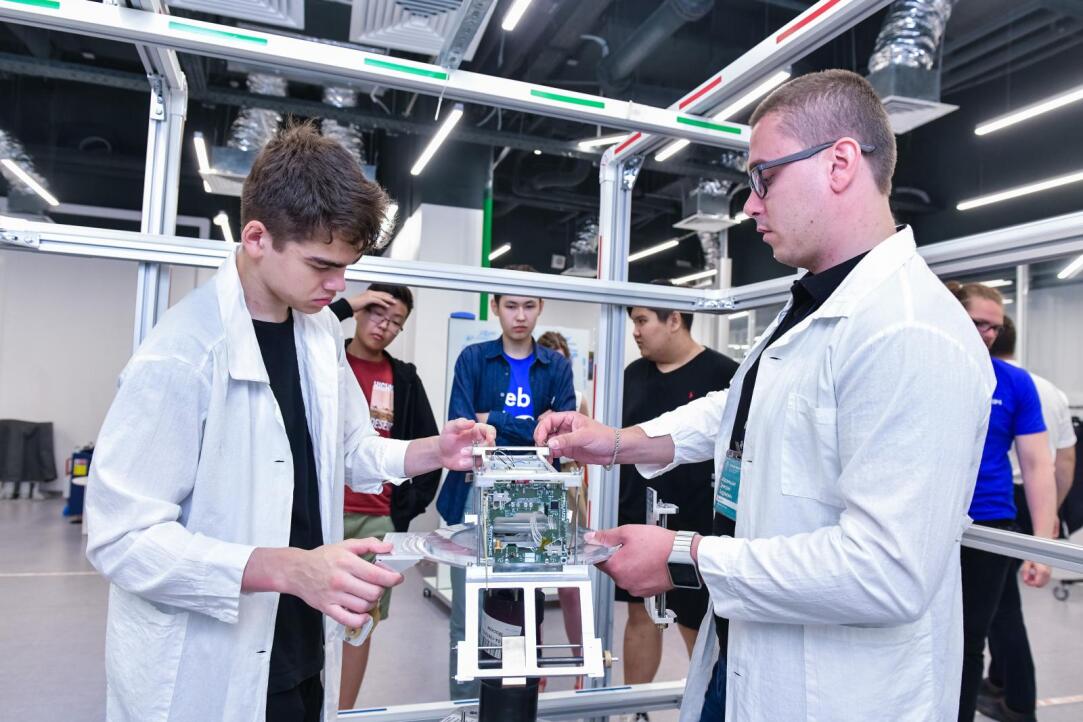
‘We Demonstrated That HSE University Can Not Only Build a Satellite, but Maintain Its Operation’
The first HSE University satellite has completed its work in orbit after more than 35,000 hours of trouble-free operation, one billion kilometres travelled (24,600 orbits around the Earth), and hundreds of full-frame shots taken of the Earth's surface across an area of 320,000 km2. The HSE News Service shares the results of the satellite’s mission and the team’s plans for the near future.

HSE University and Sultan Qaboos University Discuss Cooperation in Science and Education
On May 29, 2025, a delegation from Sultan Qaboos University paid an official visit to HSE University. The meeting was held at the HSE building on Pokrovsky Bulvar and was dedicated to the development of partnership in science and education. The delegation was led by His Highness Dr Fahad Al Said, Vice Chancellor of Sultan Qaboos University. During the visit, the parties signed an agreement on cooperation and academic exchange between the universities.

First Digital Adult Reading Test Available on RuStore
HSE University's Centre for Language and Brain has developed the first standardised tool for assessing Russian reading skills in adults—the LexiMetr-A test. The test is now available digitally on the RuStore platform. This application allows for a quick and effective diagnosis of reading disorders, including dyslexia, in people aged 18 and older.

HSE Scientists Explain How to Identify Brain Areas Critical for Language Function During Surgery
The HSE Centre for Language and Brain conducted a course on tractography, a method that enables visualisation of key brain connections and helps surgeons avoid damaging language-critical areas during surgery. The course was attended by neurosurgeons and radiologists from Moscow and other Russian regions who are interested in methods of preoperative language mapping.

'The Branch of Medicine That Our Developments Primarily Target Is Cardiology'
The application of mathematical models to the diagnosis and treatment of cardiovascular diseases contributes to the effective detection of patient predispositions and supports the selection of best treatment strategies. The use of mathematical models helps create new diagnostic tools and train neural networks to assist clinicians. Researchers from HSE University and colleagues from Saratov State Medical University are engaged in this work as part of the Mirror Laboratories project. In this interview, Natalya Stankevich, Senior Research Fellow at the International Laboratory of Dynamical Systems and Applications of the HSE Campus in Nizhny Novgorod, talks about what the collaboration has achieved so far.

HSE and Vietnam National University to Establish Joint Research Institute
A cooperation agreement has been signed in Moscow between HSE University and Vietnam National University, Hanoi (VNU). The document was signed during the official visit of a Vietnamese delegation to celebrations marking the 80th anniversary of Victory Day and negotiations involving President of the Russian Federation Vladimir Putin and General Secretary of the Central Committee of the Communist Party of Vietnam Tô Lâm. The agreement was signed by HSE Rector Nikita Anisimov and VNU Rector Le Quan.

HSE University Signs Cooperation Agreements with Leading Chinese Universities
On May 8, 2025, in Moscow, in the presence of Russian President Vladimir Putin and Chinese President Xi Jinping, strategic agreements were signed between the HSE University and two of China's top institutions, Peking University and Tsinghua University. The event was attended by Nikita Anisimov, Rector of HSE University, Qiu Yong, Secretary of the CPC Tsinghua University Committee, and Gong Qihuang, President of Peking University. The signing unfolded during the official visit of the Chinese delegation to Russia, coinciding with the commemoration of the 80th Anniversary of Victory Day.
Abstracts submission - August 10, 2025