

'The Emerging Trends in Africa Will Shape the World Order, and We Need to Be Prepared for That'

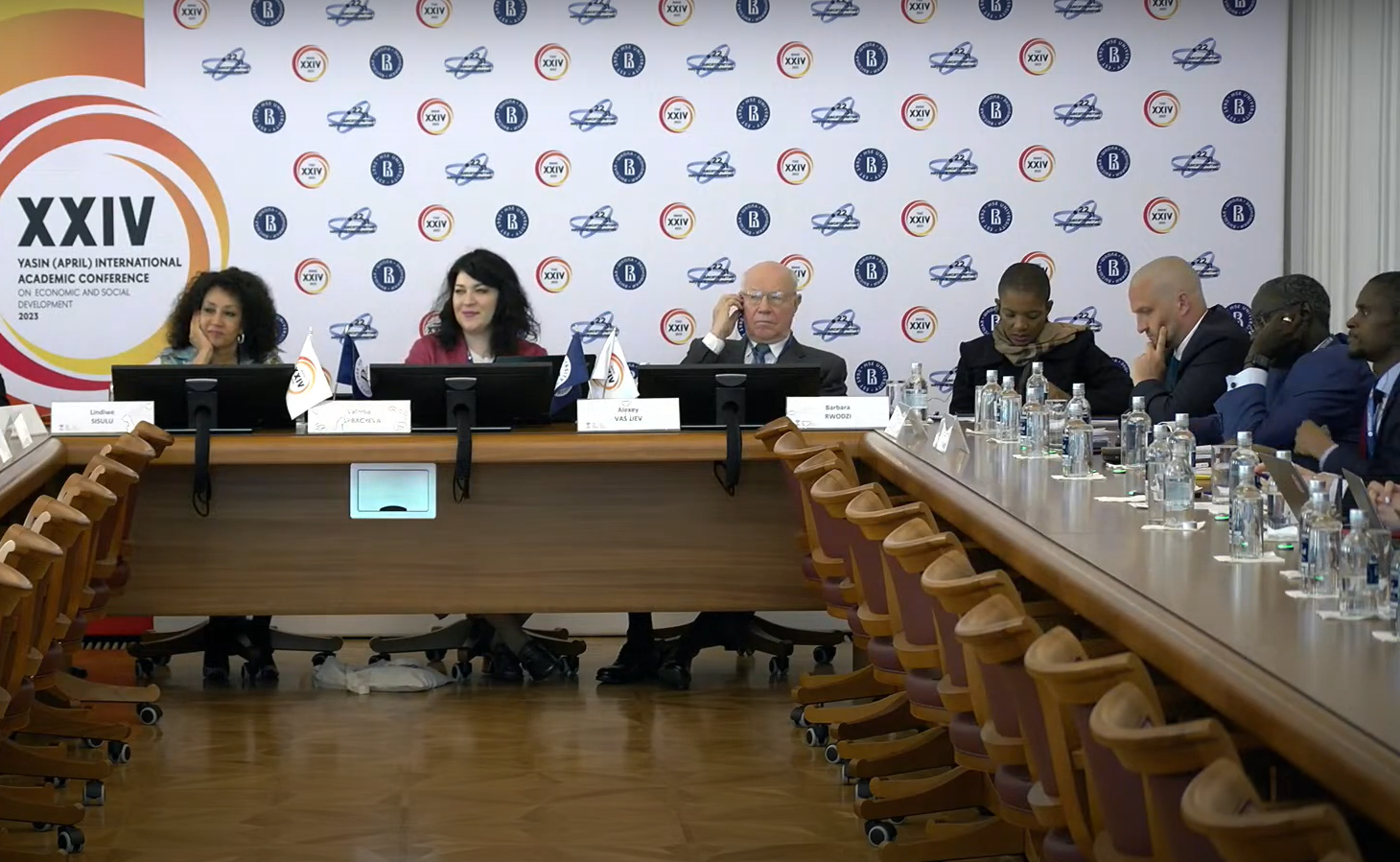
Africa has the potential to become a new economic giant. Today, African countries are interested in comprehensive cooperation and strengthening their positions in the global arena, and they look forward to receiving assistance from Russia and China in developing their technology, economy, and social sphere. Effective engagement with Africa requires training a greater number of professional African studies specialists. The XXIV Yasin (April) International Academic Conference at HSE University featured a plenary session on 'Africa in a Changing World'.
The session moderator Valeriia Gorbacheva, Head of the HSE Multilateral Strategic Project Office, emphasised that Africa is rich not only in natural resources but also in human capital, which is the core resource of the Fourth Industrial Revolution. The continent has the largest percentage of young people globally.
Gorbacheva expressed confidence that during the current century, Africa will become the fastest growing continent, not only in terms of demographics, but also economically and politically. Nevertheless, Africa is likely to face significant turbulence, as many of its countries are still in early stages of development, which could result in new interstate and interethnic conflicts. This highlights the importance of building sustainable links among African nations and economies.
It is essential that relations between Russia and African countries unfold on an equal partnership basis.
According to Lindiwe Sisulu, Minister of Tourism of the Republic of South Africa and Member of the National Executive Committee of the African National Congress, ‘The era ahead of us will result in a new order with seismic changes in global institutions and rules. Africa’s influence and role in defining this new order will be more significant than at any other time, because Africa’s place in the world has changed.’
Ms Sisulu recalled the historical crossroads in the third century BC when Carthage, led by Hannibal, was at war with Ancient Rome, and the outcome ultimately influenced the relationship between Europe and Africa. African countries today exhibit significant variation in their ethnic and religious composition, as well as their level of economic development and the quality of their public administration.
She stressed the role of intergovernmental political bodies, such as the Organisation of African Unity and the African Union, that have played a critical role in the fight against neo-colonialism and in shaping Africanism as a model of cooperation across the continent and engagement with other countries.
African countries are interested in comprehensive cooperation and strengthening the continent's position in the global arena. According to Lindiwe Sisulu, African nations must play the main role in addressing the challenges faced by the continent, and to make this possible, neo-colonialism must be defeated.
The South African politician emphasised, ‘Africa has more to gain from entangling itself with the fortunes of China and Russia in the context of global power politics. We’ve chosen the right path, and this is the path that we are following.’
According to Honorary President of the Institute for African Studies of the Russian Academy of Sciences Alexey Vasiliev, meaningful cooperation with Africa necessitates a deeper understanding of the prospects for human development. At a time when the populations of many European countries, Japan, and South Korea are declining, Africa is going to be the only source of additional human resources—soon, one in four people living on the planet will be African. The academician is confident that with proper investment in agriculture and mineral fertilisers, African countries could be self-sufficient in terms of food production.
He also predicted that in the coming decades, Africa will continue to develop at a faster pace than the West. While Vasiliev believes that Africa has the potential to become a new economic giant, he does not expect this to occur 'tomorrow or the day after'. Furthermore, in the near future, the continent is likely to experience new coups-d'etat, interethnic and interreligious conflicts. In the new multipolar world, a united Africa must develop its own solutions to the continent's challenges, independent of ideas originating in the West.
Speaking about Russian-African cooperation, Vasiliev admitted that it is difficult now for Russia to come back to Africa. Russia's return to the continent must be based not only on a positive shared history, but also on jointly leveraging opportunities such as expertise in the mining and petroleum industries. Russia can help African countries in the production of fertilisers to enhance agriculture and in developing healthcare. According to Vasiliev, there is a need for greater cooperation in the energy sector, and the construction of a nuclear power plant in Egypt demonstrates the potential for establishing such cooperation in a relatively short period. Vasiliev also believes that the recent history of Africa provides ample cause for optimism about the continent’s future.
Jean-Baptiste Tiatié Tine, Ambassador of the Republic of Senegal to Russia, observed that the continent's large population and expansive territory are both a source of strength and a potential weakness. In areas where a significant portion of the land and resources are either unused or unsuitable for use, high population density can result in severe challenges in accessing essential resources like food.
Today, African countries require sustainable development, stability, security, and active participation in international cooperation.
The Ambassador of Senegal believes that in the current circumstances, partnership with Russia is important for African countries in terms of accelerating economic and technological advancement. Collaboration in maritime, rail, and air transport, as well as agriculture, can play a crucial role, and it is essential to coordinate such projects across countries.
Andrey Maslov, Director of the HSE Centre for African Studies, observed a remarkable surge in demand for African studies specialists, in particular among businesses interested in establishing relations with African partners. Maslov emphasised the significance of creating concrete proposals based on existing expertise for the Russia–Africa summit scheduled for July. He also suggested facilitating visa regimes for nationals of African countries travelling to Russia and implementing measures to enhance the exchange of information.
According to Maslov, a growing number of African students in Russian universities and a better enrolment selection process have contributed to building relations with African countries. 'We need to train opinion leaders and public administrators to help them establish themselves as professionals,' said the head of the HSE Centre for African Studies. Russia should train African students so that they may go back to their countries rather than migrate to Europe. 'We need to increase the planning horizon to 20 years, rather than just one year or the next summit. Each dollar we invest in Africa will return to us. Investment in human potential and information sharing must become the foundation of our presence in Africa,' Maslov concluded.
Leonid Issaev, Deputy Director of the HSE Centre for Stability and Risk Analysis, expressed confidence in Africa's expanding role in the future world, citing the rising number of people from various countries traveling to the continent.
He explained that while the current global crisis carries great risks for the continent, it also opens up new opportunities for African countries. ‘We're witnessing Middle Eastern countries that have demonstrated the political courage and skill to pursue pragmatic policies reaping the benefits of the crisis. African countries that assert their position in the world could potentially acquire the same advantages in the future,' he said. Issaev described the continent's development trends as highly diverse, with significant levels of poverty existing alongside rapid growth and abundant resources being countered by increasing competition, particularly for water. While Africa's global position is expanding, the countries are faced with the challenges of terrorism, separatism, and interstate and interethnic conflicts.
'I have no doubt that the emerging trends in Africa will shape the world order, and we need to be prepared for that so that the turning point when Africa becomes a global leading force does not come as a shock to us,' Issaev concluded.
Other participants of the session included Vladimir Shubin, Principal Research Fellow at the Institute for African Studies of the Russian Academy of Sciences and and Honorius Causa, University of the Western Cape; Ezzat Saad El Sayed, Director of the Egyptian Council for Foreign Affairs; Rasigan Maharaj, Chief Director of the Institute for Economic Research on Innovation, Tshwane University of Technology (South Africa); and Barbara Rwodzi, Deputy Minister of Environment, Climate, Tourism and Hospitality Industry of Zimbabwe.
See also:

Applications to Participate in April International Academic Conference Now Open
HSE University is now accepting proposals to present academic reports at the XXVI April International Academic Conference named after Evgeny Yasin. Applications can be submitted until December 16, 2025. The conference events will take place mainly on-site in Moscow from April 14 to 17, 2026.
24 Countries Represented at 25th Yasin International Academic Conference Held by HSE University
The Programme Committee of the 25th Yasin (April) International Academic Conference on Economic and Social Development has summed up the initial results. In 2025, 1,384 people from 24 countries and 29 Russian regions participated in the conference, with 335 of them delivering presentations.
Stuck in the Net: How Much Time Children Spend Online
On average, a schoolchild spends 48 hours a week on studies—equivalent to a six-day working week for an adult. This was highlighted by experts at the round table ‘Domains of Children’s Well-Being Evaluation for Human Potential and Evidence-Based Social Policy Development,’ held as part of the 25th Yasin (April) International Academic Conference.
Russian and Chinese Scholars Share Experience of Transformation of Doctoral Education
The Russian and Chinese postgraduate education systems originally borrowed their institutional frameworks from the Soviet Union. However, in the 21st century, they have evolved along different paths. While key performance indicators for postgraduate programmes in Russia are declining, China is seeing a rapid increase in the number of postgraduate students. These contrasting trajectories and the reforms undertaken in each country in recent decades were the focus of a roundtable discussion held as part of the 25th Yasin (April) International Academic Conference.
Nobel Laureate Proposes Solution to Markov Equilibrium Problem
In dynamic games, a Markov equilibrium involves strategies that guide players' behaviour based on the current state of the game, rather than its entire history. This approach is effective when players have access to complete information. But when uncertainty arises in the game—for instance, when players are unsure of who they are dealing with—this approach can become problematic. Eric Maskin, Nobel Laureate in Economics and Professor at Harvard University, addressed this issue in a paper presented at the XXV Yasin (April) International Academic Conference on Economic and Social Development held at HSE University from April 15 to 18, 2025.
‘The World Is Becoming More Complex and Less Predictable’: What Scientists Say about the Future
The future is now more difficult for researchers to forecast, and events that are hard to predict are playing an increasingly significant role. But there is good news too: scientists are confident that humanity will adapt to any changes. This was the focus of discussion at the International Symposium ‘Foresight in a Rapidly Changing World,’ which took place as part of the 25th Yasin (April) International Academic Conference.
Fragmentation and Bloc Formation: How the Global Economy is Changing
Sergey Dubinin, former head of the Bank of Russia and Professor of Finance and Credit at the Faculty of Economics at Moscow State University, has delivered an honorary address at the XXV Yasin (April) International Academic Conference. He spoke about the transformation of the global monetary and financial system, as well as the Russian economy.
More Children, More Happiness: HSE Experts Study Impact of Number of Children on Russians' Assessment of Happiness
Russians with children feel happier than those without children. At the same time, the number of children influences the assessment of happiness: the more children Russians have, the happier they feel. These conclusions were outlined inthe report ‘More Children, More Happiness: The Impact of the Number of Children on Russians’ Assessment of Happiness,’ presented at the XXV Yasin (April) International Academic Conference on Economic and Social Development, held on April 15–18 at HSE University. The study was conducted by Elena Churilova, Senior Research Fellow, and Dmitry Jdanov, Chief Research Fellowat HSE International Laboratory for Population and Health.
HSE Expands Cooperation with Gulf Countries
HSE University and the Centre for International Policy Research (Qatar) have agreed to collaborate in the field of social sciences, with plans for joint research, academic exchanges, and regular expert engagement. The agreement was signed during the roundtable ‘State Capacity and State Resilience in the Global South,’ held as part of the 25th Yasin (April) International Academic Conference at HSE University.
‘We Grow Old before We Become Rich’: How BRICS Countries Can Achieve Economic Growth
Due to population aging, many countries aiming for economic prosperity have limited time left to undergo economic transformation, according to the honorary report Narratives Versus Reality on Employment and Demography: How Undermining Institutions Can Push Countries Out of the ‘Narrow Corridor’ by Santosh Mehrotra of the University of Bath. The report was presented at the XXV Yasin (April) International Academic Conference.