

How Are Russian Cities Different from Western Cities?
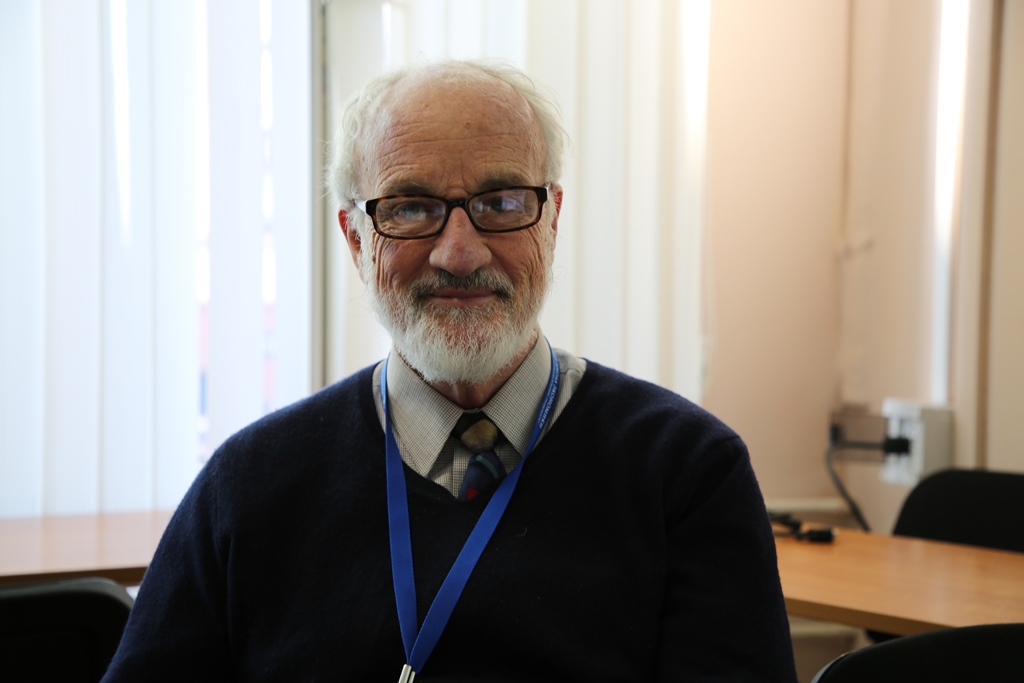
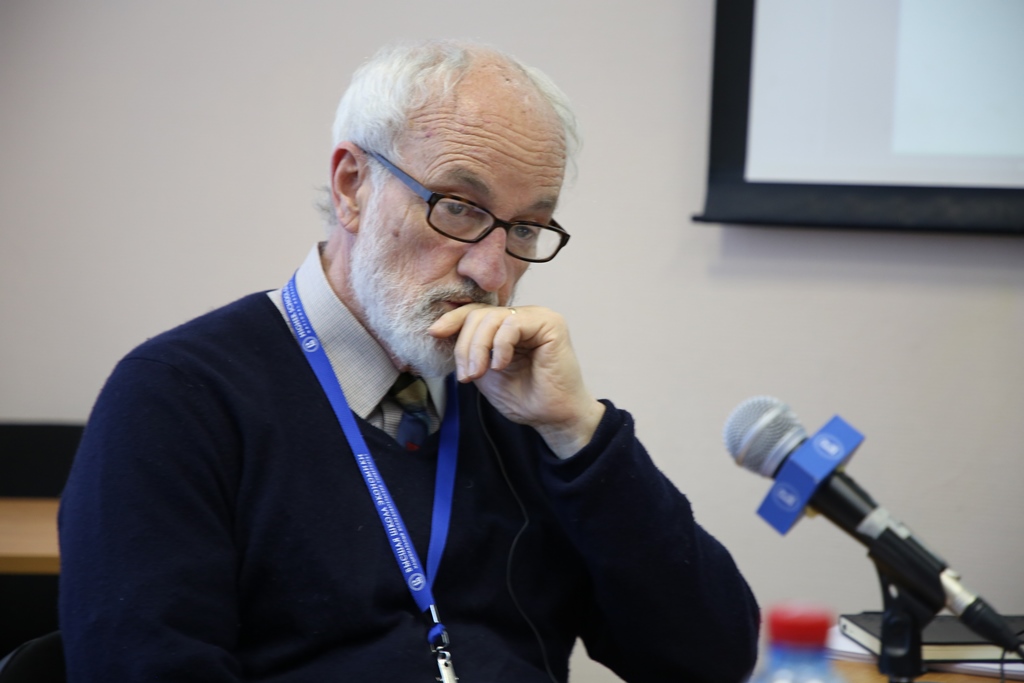
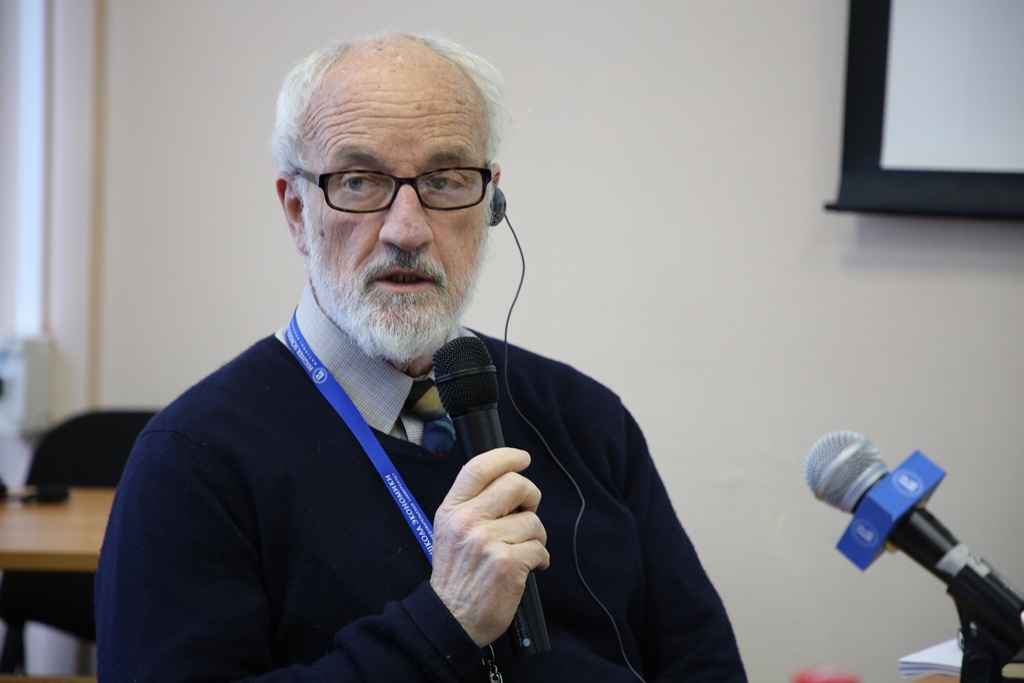
One of the roundtables held during the XIX April Academic Conference featured a discussion of the report on morphology of Russian cities presented by Robert Buckley, Senior Fellow in the Graduate Program in International Affairs at The New School, US. The report looked at what Russian cities look like in terms of population density, how the patterns Russian cities exhibit compare with those of other cities around the world, and what individual behaviours might have contributed to the appearance of a certain pattern.
Cities and Tent Poles
Generally, morphology of the cities is one of the strongest empirical regularities in economics. Most cities follow certain common patterns in terms of population density. If the population density of city is mapped against the distance from the city centre, the resulting shape often looks like the top of a circus tent with a pole. Thus, cities with high population density in the centre have a negative density gradient, whereas others with a positive gradient will have more people residing in the further from the city centre. It is also possible to have several ‘tent poles’ or spikes of population density in a city. All these patterns usually find an explanation in the economic behaviours of its residents.
It appears that most cities ‘west of Budapest and east of Los Angeles’ have a negative density gradient. The land in the centre of such cities is very valuable, so the buildings are quite tall
It appears that most cities ‘west of Budapest and east of Los Angeles’ have a negative density gradient. The land in the centre of such cities is very valuable, so the buildings are quite tall. As Professor Buckley noted, there ‘structure substitutes for land’ leading to the appearance of ‘monocentric’ cities. As population and income grow, poly-centered cities may appear. Evidence shows that most European cities are strongly monocentric. They often have extreme urban planning regulations and rigid enforcement of laws. If a city is not monocentric, there is typically a policy explanation for that – for instance, in Cape Town part of the population was relegated to the outskirts or in Brasilia the urban design was based on a modernist idea of creating a new capital in a completely new location.
Cities as Ski Slopes
What is important in analyzing the morphology of the cities is the shape of the density/location curve, and not the density figures themselves. If we compare the curve with a ski slope, all cities can be described as various types of ski slopes. Thus, most Western European cities will be ‘expert slopes’ with population density going down very quickly as we move from the city centre, while Eastern European cities have ‘milder intermediate slopes’ with a more gradual decrease.
The morphology of Russian cities is quite unusual by comparison. Out of thirteen cities analysed, there appeared:
- six cities with expert slopes and enormous early moguls where density declines for some distance and then rises sharply before decreasing again (St. Petersburg, Rostov, Ufa, Yekaterinburg, Volgograd, and Novosibirsk).
- two cities with ‘cross-country slopes’, that is with flat gradients that mean that density does not decline for some distance (Chelyabinsk and Samara);
- one city with a pattern like that produced by a heart monitor, i.e. completely erratic and resembling an EKG or Fourier series (Omsk)
- four cities with a positive gradient where population density increases towards the outskirts (Moscow, Kazan, Nizhny Novgorod, and Perm).
Most Western European cities will be ‘expert slopes’ with population density going down very quickly as we move from the city centre, while Eastern European cities have ‘milder intermediate slopes’ with a more gradual decrease
According to Professor Buckley, deviation from the standard ‘negative gradient’ pattern represents economic inefficiency. He posits that in countries with market economy or even in former Soviet block countries, such as Hungary with its ‘goulash communism’ with somewhat lax control, the market forces inevitably led to the emergence of negative gradient pattern, whereas the strict command economy in the Soviet Union did not allow for spatial optimization because the regime didn’t pay attention to land costs. One would think that the allocation of such a system would change when the system did but it appears to be doing so very slowly and seems to be costly.
There might be various explanations for why Soviet-based morphologies still persist 25 years after the collapse of the Soviet Union. It may be due to the physical or topological conditions of an area where the city is located or the fact that buildings represent long-lived capital stock. However, Professor Buckley offered another hypothesis linking the nature of patterns Russian cities demonstrate to contracting problems.
Why Privatization Did Not Work as Planned
The idea of privatization in Russia was to give everyone property so that they could respond to resource costs. However, it did not produce the desired result. Firstly, negotiating property uses in large, run-down buildings on large estates with diffused ownership is difficult. It is an example of the ‘tragedy of anti-commons’ - instead of too many having unfettered use rights, too many have control rights, which destroys value because a decision cannot be reached. The fact that income distribution in a given building may be very uneven compounds the problem. Often there will be pensioners living in a building and they will be opposed to costly repair initiatives or attempts to repurpose the building. Secondly, transport and utilities in Russia remain to be subsidized to a certain extent. Besides, many residential buildings have long outlived their useful lives. Put simply, people living in old residential areas in the outskirts do not realize the full cost of their housing that includes deferred maintenance, utilities, and transport. If they did, they would be motivated to relocate. Since this is not happening, deterioration and misallocations of buildings continue and land use changes very slowly.
Negative Consequences
Failure to reach agreement leads to inability to repurpose more convenient sites, higher vacancies in peripheral locations, greenfield construction rather than repurposing sites and reduced mobility across cities. What’s more important, it leads to the lack of land supply for housing, as it is difficult to reconfigure existing non-optimal uses. As a result, prices increase and it becomes difficult for people to afford housing. This impedes locational productivity because people cannot move to a place with high productivity. Consequently, economic growth is slower and the country’s economy suffers.
Failure to reach agreement leads to inability to repurpose more convenient sites, higher vacancies in peripheral locations, greenfield construction rather than repurposing sites and reduced mobility across cities
There are a number of policies that could help overcome the Anti-Commons Problem but there is also a prior distributional problem that makes the policies difficult to pursue. Moving to market-based spatial allocation would require making the gradients steeper, smoothing the ‘moguls’ and dismantling the positive gradient through a variety of initiatives.
Some solutions Professor Buckley has suggested include:
- recognizing a lower number of negotiators for agreement on building use at least on some sites;
- encouraging the production of multi-family rental buildings;
- introduction of land taxes to increase the cost of negotiation delays;
- recognizing that subsidies for transport and utilities are, in part, the result of contracting problems.
Prepared by Maria Besova
See also:

Applications to Participate in April International Academic Conference Now Open
HSE University is now accepting proposals to present academic reports at the XXVI April International Academic Conference named after Evgeny Yasin. Applications can be submitted until December 16, 2025. The conference events will take place mainly on-site in Moscow from April 14 to 17, 2026.
HSE Discusses Urban Development Prospects at the Vysokovsky Forum
The annual Vysokovsky Forum, organised by the Faculty of Urban and Regional Development, was held at HSE University. Officials, business representatives, teachers, and experts gathered to discuss whether development projects should be adapted to residents' needs, whether New Moscow could become a new centre of attraction, and what benefits HSE will gain from launching a new academic department in partnership with A101 Group.
24 Countries Represented at 25th Yasin International Academic Conference Held by HSE University
The Programme Committee of the 25th Yasin (April) International Academic Conference on Economic and Social Development has summed up the initial results. In 2025, 1,384 people from 24 countries and 29 Russian regions participated in the conference, with 335 of them delivering presentations.
Stuck in the Net: How Much Time Children Spend Online
On average, a schoolchild spends 48 hours a week on studies—equivalent to a six-day working week for an adult. This was highlighted by experts at the round table ‘Domains of Children’s Well-Being Evaluation for Human Potential and Evidence-Based Social Policy Development,’ held as part of the 25th Yasin (April) International Academic Conference.
Russian and Chinese Scholars Share Experience of Transformation of Doctoral Education
The Russian and Chinese postgraduate education systems originally borrowed their institutional frameworks from the Soviet Union. However, in the 21st century, they have evolved along different paths. While key performance indicators for postgraduate programmes in Russia are declining, China is seeing a rapid increase in the number of postgraduate students. These contrasting trajectories and the reforms undertaken in each country in recent decades were the focus of a roundtable discussion held as part of the 25th Yasin (April) International Academic Conference.
Nobel Laureate Proposes Solution to Markov Equilibrium Problem
In dynamic games, a Markov equilibrium involves strategies that guide players' behaviour based on the current state of the game, rather than its entire history. This approach is effective when players have access to complete information. But when uncertainty arises in the game—for instance, when players are unsure of who they are dealing with—this approach can become problematic. Eric Maskin, Nobel Laureate in Economics and Professor at Harvard University, addressed this issue in a paper presented at the XXV Yasin (April) International Academic Conference on Economic and Social Development held at HSE University from April 15 to 18, 2025.
‘The World Is Becoming More Complex and Less Predictable’: What Scientists Say about the Future
The future is now more difficult for researchers to forecast, and events that are hard to predict are playing an increasingly significant role. But there is good news too: scientists are confident that humanity will adapt to any changes. This was the focus of discussion at the International Symposium ‘Foresight in a Rapidly Changing World,’ which took place as part of the 25th Yasin (April) International Academic Conference.
Fragmentation and Bloc Formation: How the Global Economy is Changing
Sergey Dubinin, former head of the Bank of Russia and Professor of Finance and Credit at the Faculty of Economics at Moscow State University, has delivered an honorary address at the XXV Yasin (April) International Academic Conference. He spoke about the transformation of the global monetary and financial system, as well as the Russian economy.
More Children, More Happiness: HSE Experts Study Impact of Number of Children on Russians' Assessment of Happiness
Russians with children feel happier than those without children. At the same time, the number of children influences the assessment of happiness: the more children Russians have, the happier they feel. These conclusions were outlined inthe report ‘More Children, More Happiness: The Impact of the Number of Children on Russians’ Assessment of Happiness,’ presented at the XXV Yasin (April) International Academic Conference on Economic and Social Development, held on April 15–18 at HSE University. The study was conducted by Elena Churilova, Senior Research Fellow, and Dmitry Jdanov, Chief Research Fellowat HSE International Laboratory for Population and Health.
HSE Expands Cooperation with Gulf Countries
HSE University and the Centre for International Policy Research (Qatar) have agreed to collaborate in the field of social sciences, with plans for joint research, academic exchanges, and regular expert engagement. The agreement was signed during the roundtable ‘State Capacity and State Resilience in the Global South,’ held as part of the 25th Yasin (April) International Academic Conference at HSE University.