

Researchers Present the Rating of Ideal Life Partner Traits

An international research team surveyed over 10,000 respondents across 43 countries to examine how closely the ideal image of a romantic partner aligns with the actual partners people choose, and how this alignment shapes their romantic satisfaction. Based on the survey, the researchers compiled two ratings—qualities of an ideal life partner and the most valued traits in actual partners. The results have been published in the Journal of Personality and Social Psychology.
For many years, researchers have believed that satisfaction in a romantic relationship depends on how well one’s partner fits the ideal image of them, including factors such as intelligence, sense of humor, and appearance. This idea is supported by the ‘matching hypothesis.’ Scientists have repeatedly tested this theory, but results proved to be contradictory. Perhaps this is due to differences in the participants’ marital status. As a rule, the hypothesis was confirmed in studies with people in long-term relationships, but failed in experiments with participants who have not yet found a partner.
An international team of scientists from more than 40 countries, including researchers from HSE University, conducted the largest-scale verification of the matching hypothesis. The global survey involved 10,358 respondents from 43 countries, including Russia.
The researchers asked the participants to rate those traits they considered most desirable in an ideal partner and then to apply these criteria to real people they knew personally. People in a relationship described their current partner, while singles described a person with whom they would like to be in a romantic relationship.
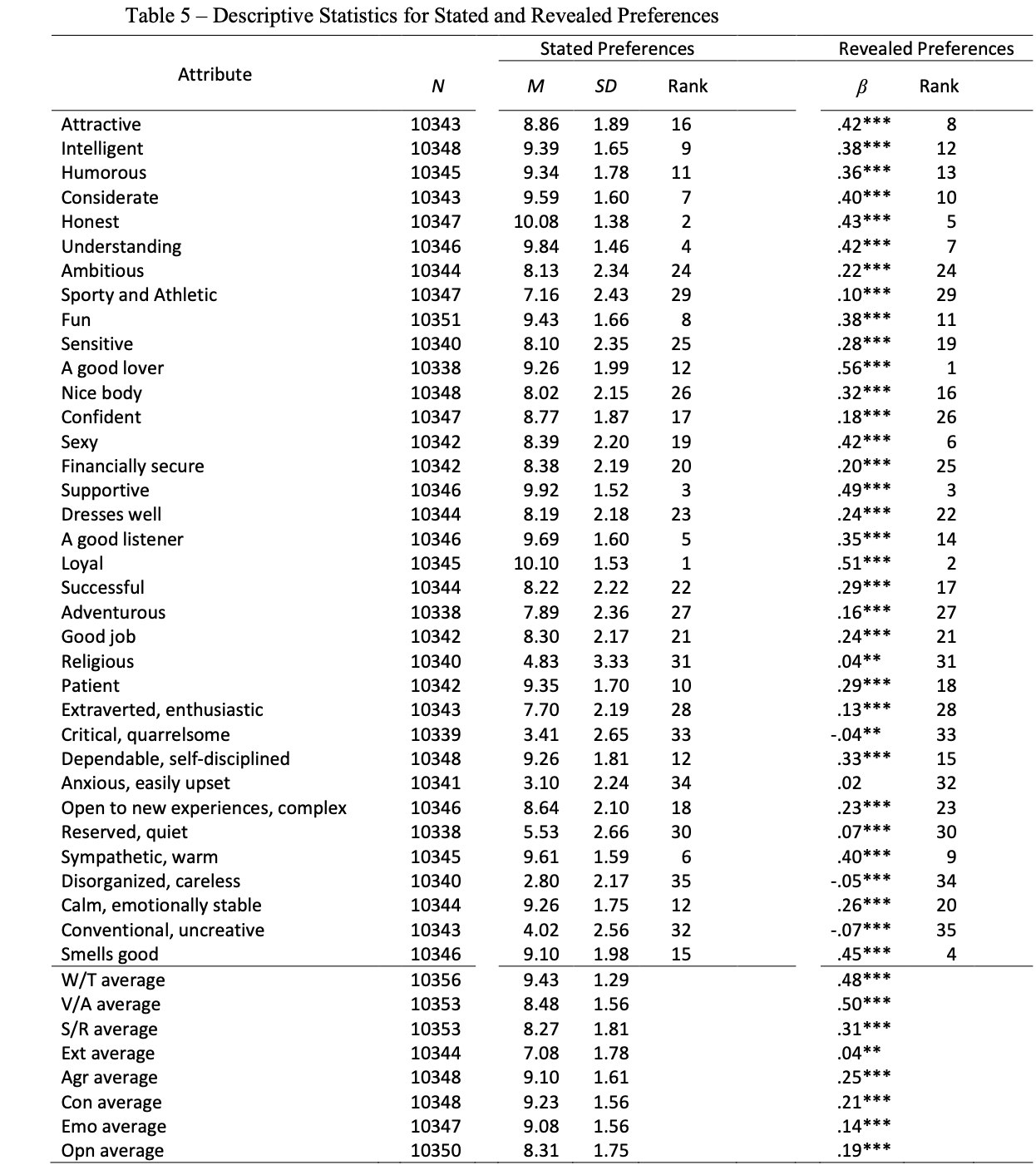
Based on the results, the authors compiled a rating of ideal partner traits (stated preferences) and a rating of traits that influence the evaluation of a real romantic partner (revealed preferences).
It turned out that the stated and revealed preferences mostly coincided, albeit with some interesting discrepancies. For instance, such qualities as ‘confident,’ ‘a good listener,’ ‘patient,’ and ‘calm’ showed a significantly higher rating in the list of stated preferences vs revealed ones. On the other hand, such attributes as ‘attractive,’ ‘a good lover,’ ‘beautiful body,’ ‘sexy,’ and ‘smells good’ have a much higher rating among the revealed preferences. Moreover, the ‘good lover’ attribute was rated highest in terms of revealed preferences, while holding the 12th position out of 35 in terms of ideal preferences.
The researchers also looked into the differences between men and women in categories most important to people: attractiveness (the average of ‘attractive,’ ‘beautiful body,’ and ‘sexy’) and earning potential (the average of ‘ambitious,’ ‘financially secure,’ and ‘good job’). As a rule, men underestimated the importance they attached to concepts such as ‘attractiveness,’ ‘beautiful body,’ and ‘sexuality’ by about six ranks, while women underestimated these three traits by 13 ranks. As for ‘ambition,’ ‘financial security,’ and ‘good job,’ men undervalued them by an average of four ranks in their rating of ideal traits, while women, on the contrary, overvalued these traits to the same degree.

‘It turns out that both sexes underestimate the importance of attractiveness, but women much more so than men: the features they do not consider important turn out to be among the highest priorities in real life. At the same time, men underestimate—while women, on the contrary, overestimate—the importance of such qualities as ambition, financial security, and having a good job. As a result, despite the differences in the stated attitudes, in real life, men’s and women’s preferences are largely the same,’ explains Albina Gallyamova, a junior research fellow at the HSE Centre for Sociocultural Research. ‘However, the question remains: are our real preferences being adjusted due to the changing social structure, or are we actually much less different from each other in terms of basic attitudes than we think?’
The data obtained will help to better understand how people establish and maintain relationships. Therefore, the impact of perfect matching is slightly lower for long-term partners than for those seeking a relationship. ‘Our research shows that while matching one’s ideal does play a role, it should not be overestimated. People can form successful relationships with partners who do not fully meet their ideal criteria,’ Albina Gallyamova explains.
See also:

Larger Groups of Students Use AI More Effectively in Learning
Researchers at the Institute of Education and the Faculty of Economic Sciences at HSE University have studied what factors determine the success of student group projects when they are completed with the help of artificial intelligence (AI). Their findings suggest that, in addition to the knowledge level of the team members, the size of the group also plays a significant role—the larger it is, the more efficient the process becomes. The study was published in Innovations in Education and Teaching International.
New Models for Studying Diseases: From Petri Dishes to Organs-on-a-Chip
Biologists from HSE University, in collaboration with researchers from the Kulakov National Medical Research Centre for Obstetrics, Gynecology, and Perinatology, have used advanced microfluidic technologies to study preeclampsia—one of the most dangerous pregnancy complications, posing serious risks to the life and health of both mother and child. In a paper published in BioChip Journal, the researchers review modern cellular models—including advanced placenta-on-a-chip technologies—that offer deeper insights into the mechanisms of the disorder and support the development of effective treatments.
Using Two Cryptocurrencies Enhances Volatility Forecasting
Researchers from the HSE Faculty of Economic Sciences have found that Bitcoin price volatility can be effectively predicted using Ethereum, the second-most popular cryptocurrency. Incorporating Ethereum into a predictive model reduces the forecast error to 23%, outperforming neural networks and other complex algorithms. The article has been published in Applied Econometrics.
Administrative Staff Are Crucial to University Efficiency—But Only in Teaching-Oriented Institutions
An international team of researchers, including scholars from HSE University, has analysed how the number of non-academic staff affects a university’s performance. The study found that the outcome depends on the institution’s profile: in research universities, the share of administrative and support staff has no effect on efficiency, whereas in teaching-oriented universities, there is a positive correlation. The findings have been published in Applied Economics.
Physicists at HSE University Reveal How Vortices Behave in Two-Dimensional Turbulence
Researchers from the Landau Institute for Theoretical Physics of the Russian Academy of Sciences and the HSE University's Faculty of Physics have discovered how external forces affect the behaviour of turbulent flows. The scientists showed that even a small external torque can stabilise the system and extend the lifetime of large vortices. These findings may improve the accuracy of models of atmospheric and oceanic circulation. The paper has been published in Physics of Fluids.
Solvent Instead of Toxic Reagents: Chemists Develop Environmentally Friendly Method for Synthesising Aniline Derivatives
An international team of researchers, including chemists from HSE University and the A.N. Nesmeyanov Institute of Organoelement Compounds of the Russian Academy of Sciences (INEOS RAS), has developed a new method for synthesising aniline derivatives—compounds widely used in the production of medicines, dyes, and electronic materials. Instead of relying on toxic and expensive reagents, they proposed using tetrahydrofuran, which can be derived from renewable raw materials. The reaction was carried out in the presence of readily available cobalt salts and syngas. This approach reduces hazardous waste and simplifies the production process, making it more environmentally friendly. The study has been published in ChemSusChem.
How Colour Affects Pricing: Why Art Collectors Pay More for Blue
Economists from HSE University, St Petersburg State University, and the University of Florida have found which colours in abstract paintings increase their market value. An analysis of thousands of canvases sold at auctions revealed that buyers place a higher value on blue and favour bright, saturated palettes, while showing less appreciation for traditional colour schemes. The article has been published in Information Systems Frontiers.
New Method for Describing Graphene Simplifies Analysis of Nanomaterials
An international team, including scientists from HSE University, has proposed a new mathematical method to analyse the structure of graphene. The scientists demonstrated that the characteristics of a graphene lattice can be represented using a three-step random walk model of a particle. This approach allows the lattice to be described more quickly and without cumbersome calculations. The study has been published in Journal of Physics A: Mathematical and Theoretical.
Scientists Have Modelled Supercapacitor Operation at Molecular and Ionic Level
HSE scientists used supercomputer simulations to study the behaviour of ions and water molecules inside the nanopores of a supercapacitor. The results showed that even a very small amount of water alters the charge distribution inside the nanopores and influences the device’s energy storage capacity. This approach makes it possible to predict how supercapacitors behave under different electrolyte compositions and humidity conditions. The paper has been published in Electrochimica Acta. The study was supported by a grant from the Russian Science Foundation (RSF).
Designing an Accurate Reading Skills Test: Why Parallel Texts are Important in Dyslexia Diagnosis
Researchers from the HSE Centre for Language and Brain have developed a tool for accurately assessing reading skills in adults with reading impairments. It can be used, for instance, before and after sessions with a language therapist. The tool includes two texts that differ in content but are equal in complexity: participants were observed to read them at the same speed, make a similar number of errors, and understand the content to the same degree. Such parallel texts will enable more accurate diagnosis of dyslexia and better monitoring of the effectiveness of interventions aimed at addressing it. The paper has been published in Educational Studies.